(2 min. read)
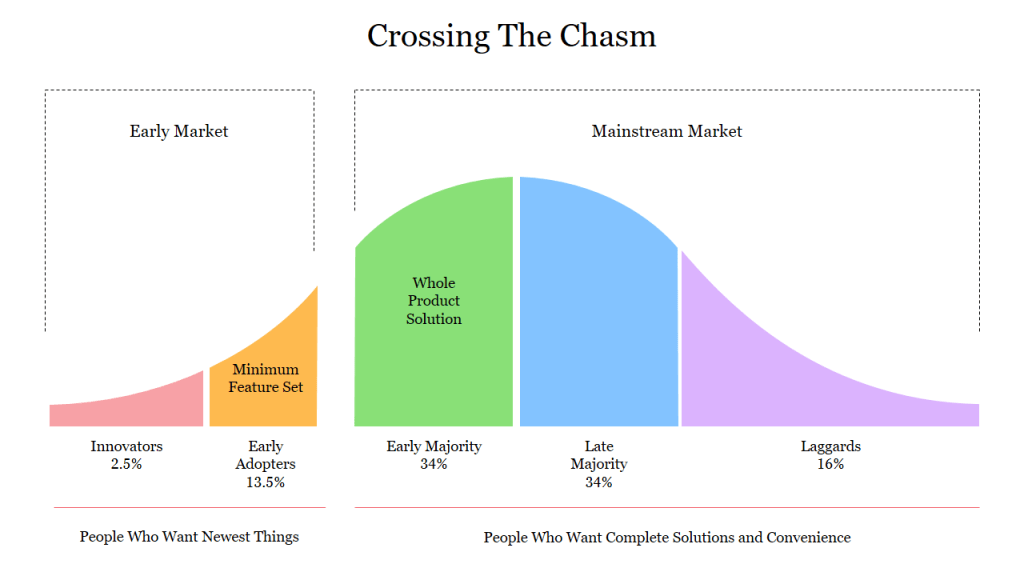
One of the most commonly used models in marketing is the product adoption lifecycle curve, a curve used to commonly describe the different levels of adoption of a total addressable market.
This model is in the shape of a bell curve, starting with innovators and early adopters, moving up to peak with the early majority, falling down with the late majority, and sputtering out with the laggards.
For the purpose of this article, we will be focusing on the relationship between the innovators/early adopters, and early majority.
Between these two groups is known as the chasm, the place that all companies need to cross to seize market dominance.
This is the most dangerous part of the lifecycle journey for new products and technologies.
Why? Because there is a paradoxical axiom of consumer behavior in the early majority that does not exist in the early adopters.
The early majority will only buy products that are established and dominating their market, even though products won’t be established and dominating the market unless the early majority buys them.
Hence, many companies fall into the chasm by failing to manage this issue, never to be seen or heard from again.
So how does one avoid this catch 22?
There is one effective strategy that when executed correctly, can allow your product to cross the chasm and explode onto the scene.
By concentrating all of your marketing resources into quickly dominating a segment of your market first and then expanding from there, you can avoid collapse.
It is better to be a big fish in a small pond than a small fish in a big pond.
By trying to appeal to your entire target market at once, you will fail every time.
By focusing all resources into capturing one market segment first, the early majority will come to see your product as established and the newest standard solution of the problem your company solves.
Moore, Geoffrey A. Crossing the Chasm Marketing and Selling Disruptive Products to Mainstream Customers. Harper Business, 2014.
 Ashton Nichols
Leave a comment